Monday, 31 January 2011

Post Consumerism

The second assignment for design studies was here already. Another week, another group meeting and further discussion. Last week we had to research 'Post Consumerism' and discover what exactly it was all about. Then on Thursday 27th at 12:30pm, I met with my group to have a quick discussion and share our views and thoughts on this up and coming topic.

There were mixed views as to the ways in which post consumerism would change people's lives but overall everyone decided that those who wanted to adapt to this way of living, would in turn have a major change in lifestyle; however the extremity of the change would be entirely up to the individual.

Post Consumerism relates to products that have been reused or recycled by consumers. It is a change in lifestyle where brands are no longer dominant and being seen in the same clothes more than once will be the 'fashion'. Those who conform to this will no longer rely on huge supermarket chains, they will grow their own food and purchase anything they can't produce themselves from local shops, their personal values will change and their 'needs' will overtake their 'wants'.

I also personally feel that through this way of living 'Sustainability' and 'Green' methods will be easily and increasingly adopted for all the right reasons, rather than a fad and a business opportunity that looks good to clients.

Below is an image of our group meeting and a quick brainstorm that we carried out on this topic:


Monday, 24 January 2011

RSA Project - CIRCLE

This was a project brief set by RSA as a student design competition. The brief was to design anything for the elderly that would make life easier at home, prolong their time at home or that could be put in place in existing purpose built housing. I chose 'B: Purpose Built Housing'. When first given the project I started to think about the stereotypical views of the elderly and the type of environment a care home provides them with. So the question that I asked myself was 'Why is it that the elderly will sit for hours and tell you all about the 'Good Old Days' and their past but they never tell you of something fun or exciting that they did yesterday?'. So I have created a pod that encompasses fun, family, being social, reminiscing and creating new memories. It also has a retro theme to take them back in time, to help them feel young again and multiple other aids to keep them and their brain active. A space they can take their family and have a good time and get away from the clinical, horrible environment of the care/retirement home whenever they want. There would be multiples of these within the grounds of the home, each individual would have their own pod. I have also given it the name 'Circle' as I believe not only are circular spaces more social - in a circle everyone is equal. These are my final presentation boards for the project:


Saturday, 6 November 2010

Bomb Project!

This week from Monday 1st November to Wednesday 3rd November all years of Interior and Environmental Design were given the 'Bomb Project'. Rightly named so, as the tutors emailed us all on Thursday last week to inform us that on Friday we would be getting a new project brief that would run for three days the following week. So we have all been jumbled up into groups all containing people from each year of my course. Not only was this to get the studio bustling and active for open days, it was to get the years mingling and get the first years more acquainted with everyone.

At first I think everybody felt the same on Friday, dread and wondering what is the point to this? I know that I have quite a lot of project work on at the minute along with my dissertation development, so it felt a bit  of a hindrance.  However, it showers your head for 3 days and would always be another experience and article of work for my portfolio.

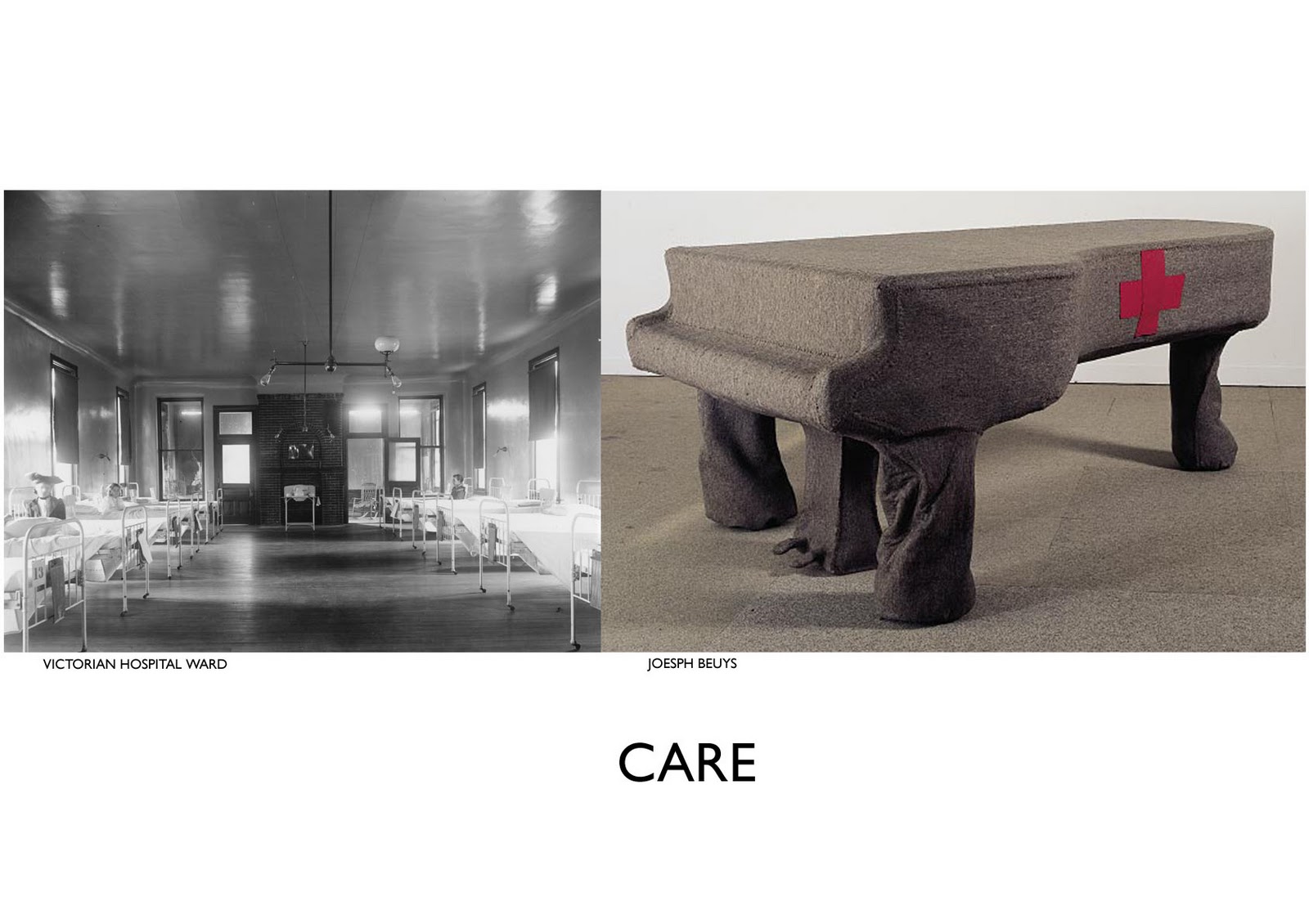
So the project brief is pretty complicated but in short, each group were given a specific topic and 2 thought evoking images. Following on from this it was up to us where we wanted to go with it as long as we produced a 2D or 3D outcome that occupied part of the studio area. Then on Wednesday the 3rd we would have a quick informal presentation of the final outcome and get some feedback from the tutors. The images we were given:


I was in Group 10, which consisted of 8 people and we were given the topic 'CARE'. On Friday afternoon we did a quick mind map of our instant thoughts of what this title meant to us. The obvious things where coming up like the elderly, cotton wool, first aid, plasters and so on. We then decided that for Monday (the official starting date for the project) we would gather images over the weekend that encompassed the meaning of 'Care'. These are the images I gathered:


As you can see I gathered a wide variety of images. Meeting up on Monday morning, a few people had not got any images but through a discussion with the images we had, it lead us on to thinking about the other end of the scale. We were thinking very obviously of the things we care for but then we asked ourselves "What about the things that we should take care off and don't? 

We also had been thinking about visual communication and signage that give you warnings and cautions e.g signs helping you take care when driving. So we decided to try to combine the two. Was there a way in which we could gather a collection of items that we should take care with but don't and add a warning symbol to them, to make people pay more attention? 

So Monday night we went home trying to think of these items and add the 'Warning' signage to them in which ever way we wanted. I decided to find some less obvious images, get them into photoshop and incorporate the warning sign in an interesting and realistic way. The images that I chose all have a variety of messages to convey, some more serious than others and some even with a double warning meaning e.g. the bottle of water. My images can be seen below:


After creating these I started to look at creating 'Warning Tags' that could be attached to other everyday objects that wouldn't necessarily be able to have the logo incorporated in or on it. I created a simple tag and attached it to everyday objects that we know we should 'take care' with but don't. For example, we know we should take care when using safety pins but how many times have you been using one and ended up pricking yourself?


Tuesday morning came and we collaborated chosen images from each person to create an evoking visual presentation. We also printed out the 'Warning' logo we had been using and created some stickers and tags. These were then attached to items around our studio area that we should all take care with but don't. This reinforcing our concept and adding a 3D level to our presentation.

Sunday, 31 October 2010

RSA - Modern Age Project

My very first project of the year was a brief produced by the RSA as a competition entitled 'Modern Age'. The brief was as follows:

"Design a domestic product or living environment for older people that surpasses conventional expectations. Either design something to help a person growing older in the home they made and know (A), or design something for a purpose-built home for the elderly that evokes the qualities of a lived-in home (B)."

Although the brief was explained further for another 3 pages, these where to the only two options I had to choose from. I started to think about the stereotypical values that are giving to the elderly and the way in which they are perceived by everyone else. The usual thoughts cropped up; slow, decrepit, boring, useless, frail and so on. But why are the elderly all tarred with this same brush? Why do we not see them the same as the rest of us? After all they have been around longer than us, know more than us, have seen many things that only we can pray we never have to see (war) and we were once as young as us. Why do we not see them as young, trendy, sexy, smart and fun?

Many sketches and mind maps later, my initial research led me to a major thought/question. Why is it that when you are sitting talking to someone elderly e.g. your granny, why do they always speak about their childhood, all the fun they used to have, everything they got up to when they were young and reminisce on all those old memories? Why do they never speak of something fun and exciting they did last week? 


Therefore, MEMORIES, would be the basis of my design. Creating a space that the elderly can call their own, where they can create new memories with family members or friends but where they can also reminisce and relish on the past memories they love so much. 


Ideally this 'memory pod' would be created and designed to be positioned within the land of nursing homes. I have chosen to do this because of a visit to a local Dundee care home - Tullideph Nursing Home. Although this home was for those with severe dementia, the interior is as clinical and horrible as the rest. The areas that were private and supposedly personal for each individual where no more homely than the rest of the place. I came home feeling so sad and upset. it made me think all sorts and you truly don't know what is in front of you. How can being old could be this horrible? You have images and thoughts of how these places will look and smell but nothing prepares you for everything you are about to experience as you walk through those doors. This had a great effect on me and I decided I wanted to create a space that people living in a home could go to, make their own and get away from the horrible environment in which they have to live. A place that they are proud of, that feels like home and that give them some responsibility. I have decided that my design would be best suited for homes containing more able elderly rather than those with a specific disability. Therefore the option I have choose is (B).

Wednesday, 31 March 2010

Assignment 5A

In my previous essay I theorised that the general public is not aware of the true effects that the media has on their lives and everyday behaviour. However, I did not have any evidence to prove this and so investigated further into a journal called ‘Suicide, Motor Vehicle Fatalities and the Mass Media: Evidence toward a Theory of Suggestion’ by David Phillips and a book called ‘Media, Communication, Culture A Global Approach’ by James Hull. The main aims of both of these was to prove that the Mass Media greatly influences human behaviour, in addition to the fact that it has a lot more control over us than we realise. They both present findings that have strong implications towards imitation and suggestion having an immense impact on social behaviour, individuals and trends within cultures. Not only did they put forward evidence to prove this, they also revealed that these concepts lie greatly within the modern society; with the media shaping almost every decision and action made by individuals on a daily basis.

Phillips had shown that the national level of suicides increases considerably for a brief period of time after a suicide story is published in a newspaper and that the increase only occurs after the publication. He shows that the more publicity a story is given the greater the effect; especially in the surrounding region of where it had been publicized.

Lull on the other hand uses historical events and recognisable brands of our modern age, to show how the mass media has had an effect on them. In turn, establishing how corporate giants such as Microsoft, would never have become household names without the media. He also reminds us that technology and the media vastly advances as the year’s progress and so the effect of cultural impact changes.

In order to prove my theory further i.e. that the mass media has an immense influential impact on the general public; there are numerous research methods that I could carry out. These methods would include interviewing and interacting with the general public in multiple ways, observing people and also trying to start trends myself, on a smaller scale. The majority of the research would provide qualitative information. Therefore, it will be up to me to delve into the research and figure out patterns, trends and any correlation between the mass media and their influence on the general public. I would also be using members from the general public i.e. strangers throughout my investigations as they will give unbiased answers and will provide a wide range of ages and socioeconomic backgrounds.

The first set of experiments that I would carry out would involve using photographs to find out information indirectly from the general public. In the first experiment of this type, I would gather around 5 photographs portraying different styles of clothing and outfits from a range of decades including our own. These would then be shown to a variety of people and they would be asked to put them in order of what they would be most likely to wear. This would be used to discover whether or not their answers correspond with the current trends in fashion and in turn could show that people are influenced by the media and what is seen to be “fashionable” by them. However, problems that could occur during this is the fact that every person has their own personal tastes and there will always be those who simply to do not conform to the norm. This is something that in reality cannot be controlled as people will always have opinions and some will always go against trends.

I would then conduct a similar investigation only this time I would select around 3 photographs, all with one type of outfit that are extremely similar. However, in one of the photographs a celebrity would be wearing the clothes. After showing people the pictures, I would ask them which outfit is their favourite or what one they are most likely to buy. This would allow me to see if people chose the photo with the celebrity, simply due to it being a worn by a celebrity. Therefore giving me an indication of how susceptible people are to celebrity endorsement and in turn the media. While this data could be quite informative there are problems, such as people deliberately not choosing the picture with the celebrity. Either due to not wanting to admit they are influenced by them or simply the fact they don’t like that particular icon. A way round this would be to have a number of these outfits all with different celebrities and test the exact same people to see how the results vary.

Observing people is another way of finding out information and is a means of viewing people acting naturally. If I were to observe a magazine stand, over a period of time, I could take notes on what type of women tend to buy each magazine. Creating this link between magazines and fashion trends would tell me what kind of impact the media is having through this medium and whether or not women are influenced on what to wear by shopping advertisements, celebrities and clothes advertisements within magazines. This would be a rather trustworthy source but a problem could be that some women don’t dress up to go to the shops and would therefore be creating a false impression. In order to tackle this I could observe them even more and take note on what type of casual wear they are wearing i.e. is it still fashionable items of casual clothing?

Another investigation I would carry out, that would give me a rapid link between media influence and people would be to get a variety of companies slogan’s and/or logo’s and ask people which company they belong to. This would reveal just how much people are being subliminally brainwashed by companies and their advertisements. In other words, revealing the power of media and the extents of it. As a source of evidence this would be extremely trustworthy as there is no reason for people to lie or hide the fact that they recognise brands.

I would also peform interviews with members from the general public and ask them about their thoughts on the topic of ‘Charity’. Using questions to find out how often they would normally give to charity and the effect that largely publicised and media hyped charity events, for example Red Nose Day, have on them. Consequently discovering if the media influences people to make donations and feel as though they should participate. This again would back up the media power of imitation and suggestion on people. However, due the delicate subject matter people could lie about their answers, as they will not want to be seen in a bad light and will naturally want to look good. The only way around this would be to engineer the questions so that they would be asked indirectly; meaning that the results are more likely to be reliable.

A final method I could use to really test the power of the media would be for me to become the source of publication. I could start a trend on a small scale, for example in my particular college at university, wearing a certain outfit a few of times a month. I would then start distributing a small number of flyers about the price of the garments of clothing or where to buy them. Insinuating, that this is the latest fashion trend and observe how many people start wearing either the full outfit or items from within it. Although this would only be on a small scale it would allow me to create a positive correlation between the affect of advertising and publicity on people.

In conclusion, all of these methods would provide me with extremely beneficial evidence towards proving that the mass media greatly influences our everyday thoughts and lives throughout all age groups and classes. They would also enable me to see which age groups or classes are most influenced.


Bibliography
Lull, James, 1995, Media, Communication, Culture A Global Approach, Polity Press in Association with Blackwell Publishers Ltd.

Phillips, David P, 1979, Suicide, Motor Vehicle Fatalities and the Mass Media: Evidence toward a Theory of Suggestion, The University of Chicago Press
Land Peel

I stumbled across this design and thought that it was quite extraordinary. We all know how uncomfortable it is to sit on a hard floor for an extensive length of time and it isn't long before your bum is numb or pins and needles are tingling in your legs and feet. This design by Shin Yamashita would stop this and allow you to sit at ease on the floor working with your laptop, reading books or simply just sitting watching television. It comprises of a flat three panel mat from which a table, seat or rest can be made simply by lifting and folding the panels.


Monday, 29 March 2010

How Do Salespeople Influence Purchases? - Assignment 4

My most recent assignment was to interact with the general public and carry out interviews with people that I had never met before. I would be carrying out these interviews with ‘ordinary’ people to find out their thoughts and attitudes towards a specific area of design that I had chosen. I prepared 15 questions for each person relating to how they felt about salespeople, as the question that I was trying to answer was ‘How do salespeople influence purchases?’. However, I wasn’t allowed to directly ask this question; I had to become a ‘detective’ as I knew people probably wouldn’t openly admit to being influenced by anything/anyone. Then once I had carried out my interviews and collected all the information I needed it was up to me to delve into their responses and try to discover discrepancies or running themes within them. This in turn would allow me to answer my question.

The 15 questions that each person was asked are as follows:
1. How do you decide what brand of product is best when you go to buy an item?

2. How do you decide what price range or budget you should stay within when purchasing something?

3. Do you generally ask for advice in shops from members of staff? Explain.

4. When you enter a shop and are looking around is there anything you notice?

5. What irritates you when you are shopping in a store such as PC World or Currys? Explain.

6. Does anything please you when you are shopping in a store such as PC World or Currys? Explain.

7. When purchasing expensive items such as laptops, cameras, TV’s, how much research would you do?

8. When purchasing your most recent car, what factors contributed most when choosing that model?

9. What are your thoughts on shopping channels?

10. What kind of impression do the presenters of shopping channels give? E.g. about things they are selling.

11. What is the most recent thing you bought? Did anyone advise you when shopping?

12. Are you easily persuaded into buying something? What are your reasons for this? Who would influence you most?

13. When choosing an expensive item to purchase who/what is your biggest source of knowledge? Do you trust this source?

14. How useful do you find staff in places selling more expensive items such as TV’s and computers?

15. When you are speaking to a salesperson what do you notice about the language they use? How does this make you feel?


Each person was also given a page with following images on it and asked to explain what each of them meant to them.


After collaborating all of my research together and reading through each of the interviews again a few patterns emerged but the majority of the answers were not out of the ordinary. Those who were bringing a large income into their home and didn’t have any financial commitments such as children tended not to do much product research and would ask salespeople for help when purchasing an item. However, this generally wasn’t for specifications or information about a product it was usually to find out which product was “in fashion”, “the best” or “most popular” at the time. This giving me the impression that because they can afford the latest items, they aren’t too concerned with the shelf life of a product, as they can easily replace the item or upgrade it. What this shows is that salespeople are involved with the purchase of goods even when they are considered to be relatively unimportant to the customer.

In the contrary, those who had a family or were of a younger generation would research a product thoroughly before purchasing through asking friends and family, searching the internet and reading a vast number of customer reviews. So due to either not having a lot of money to spend or having other financial commitments they tended be more aware of the fact that they cannot chance buying a product that isn’t right for them. This meant that when they entered into stores to buy the product they knew they wanted salespeople were classed as “irritating” and “annoying” as they didn’t really have any need for them.

Another theme that was presented to me from across the spectrum of ages was that salespeople in shops, such as PC World, tended to use a different language when speaking to their customers. This was ironic, in the fact that most people said they would generally only ask for help in shops that sold technical goods. Despite this, it was in these shops that salespeople tended to use a language that the everyday person couldn’t understand. If a salesperson is condescending, doesn’t give the information required or doesn’t directly answer the questions they are asked, people are put off and left confused. Revealing to me, that if a customer is confused or not spoken to properly they lose interest not only in the product but in the salesperson and would tend not to buy anything. In saying this, most people do find these salespeople rather helpful and admitted that “if they sounded knowledgeable I would be more likely to buy what they recommended” or “if they are enthusiastic about a product it would persuade me to purchase it”. Another factor that contributes to a sale is if a salesperson uses their formal language “correctly”. Referring to their customer as ‘Sir’ or ‘Madam’ as this “makes you feel important” and therefore made people listen to them and believe that they had their best interests in mind when recommending products. Instantly this shows that salespeople influence purchases and are a direct link between customers and sales.

The results that I received from showing people the page with the images on it were rather similar and revealed what I had expected. The picture of the clothes shop was instantly classed with “not as much help on hand” but it was also said that this was not a bad thing as “you got time to browse in peace”. These are also classed as shops that you don’t require help in as you know what you want and like; therefore salespeople are not required. However, when asked to describe the image of the mobile phone shop it was immediately voiced that salespeople here “pounce on you as soon as you enter the shop” and are “irritating”. When asked why this was so irritating people said it was because they wanted to browse in peace or generally knew what mobile phone they wanted and therefore didn’t wish to be persuaded into buying something they didn’t need.

In conclusion, it is easy to see that people either find salespeople extremely helpful or a nuisance. It also shows that the way in which salespeople are perceived depends entirely on the type of shop and the products that they are selling.