Sunday, 27 March 2011

'The Fayretrade Market'

On Wednesday 16th March my group carried out the final presentation of our 'Enterprise Project' in lectures. We had created 'The Fayretrade Market' where everyday, ordinary people could come along and trade homegrown produce with one another. The whole idea of this project was to create a business, a service or a product that would appeal to Post-Consumers. So we decided that creating a service where communities can come together and trade excess home grown produce would be ideal - not only would we bringing communities together, we would be encouraging people to 'grown their own' and not have to worry about the excess. 

Every 3 months we would hold one of these events in a local hall where anybody could come along and trade game, fruit and vegetables amongst one other. The entrance fee into each event would £6 but for those who know they will be attending all four events in the year they can purchase a 'Growers Card' and pay a one off fee of £18. 


Alongside this we will sell 'Grower Packs' at a one off cost of £20 which includes everything you need to get you growing. These packs will also be sold by large gardening suppliers and in stores such as B&Q. We have also included a booklet in the pack which contains the laws & regulations of game, where you can grow in urban areas, along with seasonal growing charts and information about our website.

In the first year we hope to get 'The Fayretrade Market' full established and well known in the Dundee area, in year two we plan to expand to Aberdeen and in year three to Edinburgh. Further expansions from year 5 onwards would include the trading of a wider range of products, more events and expansion to larger cities within the UK.


Our logo:


'Grower Pack':


Posters:


Website:

Thursday, 24 February 2011

'People's Market'

Last week my design studies group met up (17th February) to refine our thoughts and sort out the FINAL service we want to provide for our 'Enterprise' project. We started to talk about the ideas we had liked the sound of the previous week and narrow down the group favourites. Within half an hour our service was decided and we finally knew the service we wanted to provide not only post-consumers but the general public.

So the idea is based on people growing their own food - their own fruit and vegetables and greatly encouraging its continuation. However, we are also trying to get people who don't grow their own food some incentive to start and open their eyes to the benefits.

Imagine a 'Car Boot Sale' minus the household items we all want rid off and replace them with home grown produce - this can be from fruit and vegetables to game. We will provide the venue and the ability to sell on the extra food produce from your household and all the community has to do is pay a fee for a pitch each week. This will encourage people to grow their food and not worry about waste, as they will know that they can make some money from produce that they normally would throw away. This will keep people growing their own and not have to worry about food that they can't use.

We will also provide 'Starter Packs' that will contain seeds, instructions on growing food in your area, a bag of soil and a container, to get you started. It will even information about where you can grow your crop if you don't have a back garden e.g. urban dwellers. Everything you would need to get started is in this pack. Another way to get the urban environment greener and growing. There's simply no reason why people who live in busy cities can't grow their own food, just as much as someone who lives in the countryside. Urban vegetable patches are what we hope to achieve.

In a previous meeting we liked the idea of 'Recipe Swaps' and getting people within the community together. So we have decided that we are going to incorporate this into our service. People can bring their recipes along and swap produce with other sellers, so that they can potentially fulfil their ingredient list. The bartering and swapping will be down to the discretion of the people, to get themselves a good bargain. We don't want to put rules and regulations on this as we believe it will deter people and also take a bit of fun away from the haggling.

Overall this is our 'Service' so far and our next meeting will refine and consolidate these ideas further. We may also even have a brand/name by then that will get us recognised and help our service move further financially and globally. We want our trading service to be in multiple towns and cities, running weekly and bringing communities together.

Lights To Inspire

This is just a quick post about a few lamps/lights I came across that I think are pretty cool and intriguing. Looking at the images below you will see they make use of everyday objects and recycle them to their optimum potential. These show that being 'Green' and Recycling can be fun, cool, modern and exciting.


Thursday, 10 February 2011

Post-Consumer vs. Consumer


Last week my group met up again on Thursday for another meeting, this time to further redevelop the research that we had previously carried out on Post-Consumerism. We all agreed that for this week we would gather a variety of images that we thought best suited this topic and make a 'collage' of our thoughts. This would then be our poster for Assignment 2. We decided that one side of the poster would represent the lifestyles and the changes brought through Post-Consumerism and the other side would be all about Consumerism. Below are the images of our poster:


After completing this we decided that we should brainstorm ideas and niches in the Post-Consumer world - i.e. start to think of products or business opportunities that would appeal to the Post-Consumer and that would fit in with their lifestyle. This was us on our way to discovering what we would be creating for our group 'Enterprise' project. Each avenue was explored in depth and some long discussion took place to see what our initial ideas were. We managed to discover quite a few things that have potential,  however, will need a lot more research before a final decision is made. We also want to produce something different, exciting and that isn't so obvious e.g. repair shops, although an ideal concept for a post-consumer, is far too obvious, boring and they already exist. For the next meeting the plan is to research some of the ideas we preferred and then discuss them in depth together to try and narrow down a few of our ideas. Below is the brain storm we carried out:

Monday, 31 January 2011

Post Consumerism

The second assignment for design studies was here already. Another week, another group meeting and further discussion. Last week we had to research 'Post Consumerism' and discover what exactly it was all about. Then on Thursday 27th at 12:30pm, I met with my group to have a quick discussion and share our views and thoughts on this up and coming topic.

There were mixed views as to the ways in which post consumerism would change people's lives but overall everyone decided that those who wanted to adapt to this way of living, would in turn have a major change in lifestyle; however the extremity of the change would be entirely up to the individual.

Post Consumerism relates to products that have been reused or recycled by consumers. It is a change in lifestyle where brands are no longer dominant and being seen in the same clothes more than once will be the 'fashion'. Those who conform to this will no longer rely on huge supermarket chains, they will grow their own food and purchase anything they can't produce themselves from local shops, their personal values will change and their 'needs' will overtake their 'wants'.

I also personally feel that through this way of living 'Sustainability' and 'Green' methods will be easily and increasingly adopted for all the right reasons, rather than a fad and a business opportunity that looks good to clients.

Below is an image of our group meeting and a quick brainstorm that we carried out on this topic:


Monday, 24 January 2011

RSA Project - CIRCLE

This was a project brief set by RSA as a student design competition. The brief was to design anything for the elderly that would make life easier at home, prolong their time at home or that could be put in place in existing purpose built housing. I chose 'B: Purpose Built Housing'. When first given the project I started to think about the stereotypical views of the elderly and the type of environment a care home provides them with. So the question that I asked myself was 'Why is it that the elderly will sit for hours and tell you all about the 'Good Old Days' and their past but they never tell you of something fun or exciting that they did yesterday?'. So I have created a pod that encompasses fun, family, being social, reminiscing and creating new memories. It also has a retro theme to take them back in time, to help them feel young again and multiple other aids to keep them and their brain active. A space they can take their family and have a good time and get away from the clinical, horrible environment of the care/retirement home whenever they want. There would be multiples of these within the grounds of the home, each individual would have their own pod. I have also given it the name 'Circle' as I believe not only are circular spaces more social - in a circle everyone is equal. These are my final presentation boards for the project:


Saturday, 6 November 2010

Bomb Project!

This week from Monday 1st November to Wednesday 3rd November all years of Interior and Environmental Design were given the 'Bomb Project'. Rightly named so, as the tutors emailed us all on Thursday last week to inform us that on Friday we would be getting a new project brief that would run for three days the following week. So we have all been jumbled up into groups all containing people from each year of my course. Not only was this to get the studio bustling and active for open days, it was to get the years mingling and get the first years more acquainted with everyone.

At first I think everybody felt the same on Friday, dread and wondering what is the point to this? I know that I have quite a lot of project work on at the minute along with my dissertation development, so it felt a bit  of a hindrance.  However, it showers your head for 3 days and would always be another experience and article of work for my portfolio.

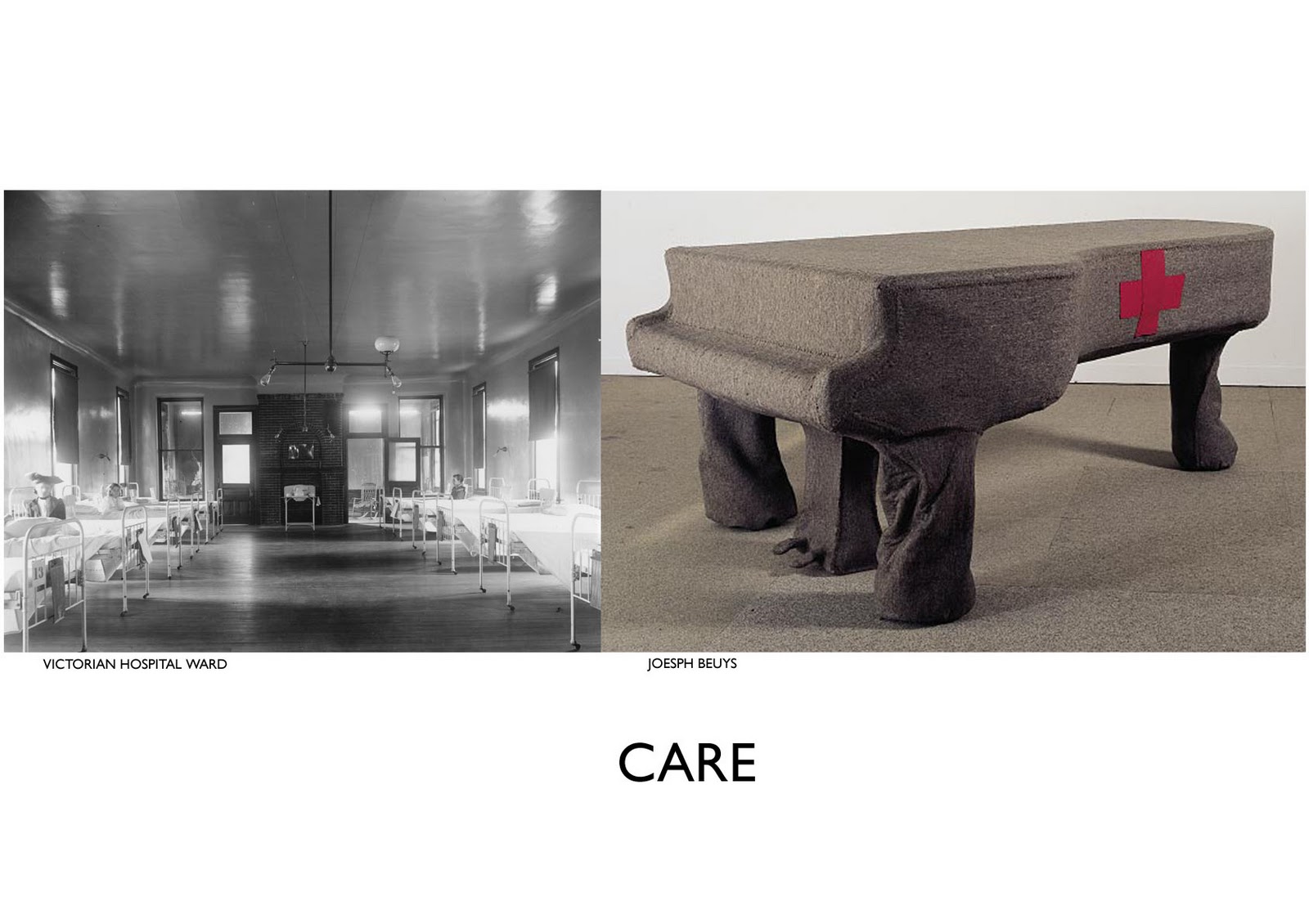
So the project brief is pretty complicated but in short, each group were given a specific topic and 2 thought evoking images. Following on from this it was up to us where we wanted to go with it as long as we produced a 2D or 3D outcome that occupied part of the studio area. Then on Wednesday the 3rd we would have a quick informal presentation of the final outcome and get some feedback from the tutors. The images we were given:


I was in Group 10, which consisted of 8 people and we were given the topic 'CARE'. On Friday afternoon we did a quick mind map of our instant thoughts of what this title meant to us. The obvious things where coming up like the elderly, cotton wool, first aid, plasters and so on. We then decided that for Monday (the official starting date for the project) we would gather images over the weekend that encompassed the meaning of 'Care'. These are the images I gathered:


As you can see I gathered a wide variety of images. Meeting up on Monday morning, a few people had not got any images but through a discussion with the images we had, it lead us on to thinking about the other end of the scale. We were thinking very obviously of the things we care for but then we asked ourselves "What about the things that we should take care off and don't? 

We also had been thinking about visual communication and signage that give you warnings and cautions e.g signs helping you take care when driving. So we decided to try to combine the two. Was there a way in which we could gather a collection of items that we should take care with but don't and add a warning symbol to them, to make people pay more attention? 

So Monday night we went home trying to think of these items and add the 'Warning' signage to them in which ever way we wanted. I decided to find some less obvious images, get them into photoshop and incorporate the warning sign in an interesting and realistic way. The images that I chose all have a variety of messages to convey, some more serious than others and some even with a double warning meaning e.g. the bottle of water. My images can be seen below:


After creating these I started to look at creating 'Warning Tags' that could be attached to other everyday objects that wouldn't necessarily be able to have the logo incorporated in or on it. I created a simple tag and attached it to everyday objects that we know we should 'take care' with but don't. For example, we know we should take care when using safety pins but how many times have you been using one and ended up pricking yourself?


Tuesday morning came and we collaborated chosen images from each person to create an evoking visual presentation. We also printed out the 'Warning' logo we had been using and created some stickers and tags. These were then attached to items around our studio area that we should all take care with but don't. This reinforcing our concept and adding a 3D level to our presentation.

Sunday, 31 October 2010

RSA - Modern Age Project

My very first project of the year was a brief produced by the RSA as a competition entitled 'Modern Age'. The brief was as follows:

"Design a domestic product or living environment for older people that surpasses conventional expectations. Either design something to help a person growing older in the home they made and know (A), or design something for a purpose-built home for the elderly that evokes the qualities of a lived-in home (B)."

Although the brief was explained further for another 3 pages, these where to the only two options I had to choose from. I started to think about the stereotypical values that are giving to the elderly and the way in which they are perceived by everyone else. The usual thoughts cropped up; slow, decrepit, boring, useless, frail and so on. But why are the elderly all tarred with this same brush? Why do we not see them the same as the rest of us? After all they have been around longer than us, know more than us, have seen many things that only we can pray we never have to see (war) and we were once as young as us. Why do we not see them as young, trendy, sexy, smart and fun?

Many sketches and mind maps later, my initial research led me to a major thought/question. Why is it that when you are sitting talking to someone elderly e.g. your granny, why do they always speak about their childhood, all the fun they used to have, everything they got up to when they were young and reminisce on all those old memories? Why do they never speak of something fun and exciting they did last week? 


Therefore, MEMORIES, would be the basis of my design. Creating a space that the elderly can call their own, where they can create new memories with family members or friends but where they can also reminisce and relish on the past memories they love so much. 


Ideally this 'memory pod' would be created and designed to be positioned within the land of nursing homes. I have chosen to do this because of a visit to a local Dundee care home - Tullideph Nursing Home. Although this home was for those with severe dementia, the interior is as clinical and horrible as the rest. The areas that were private and supposedly personal for each individual where no more homely than the rest of the place. I came home feeling so sad and upset. it made me think all sorts and you truly don't know what is in front of you. How can being old could be this horrible? You have images and thoughts of how these places will look and smell but nothing prepares you for everything you are about to experience as you walk through those doors. This had a great effect on me and I decided I wanted to create a space that people living in a home could go to, make their own and get away from the horrible environment in which they have to live. A place that they are proud of, that feels like home and that give them some responsibility. I have decided that my design would be best suited for homes containing more able elderly rather than those with a specific disability. Therefore the option I have choose is (B).

Wednesday, 31 March 2010

Assignment 5A

In my previous essay I theorised that the general public is not aware of the true effects that the media has on their lives and everyday behaviour. However, I did not have any evidence to prove this and so investigated further into a journal called ‘Suicide, Motor Vehicle Fatalities and the Mass Media: Evidence toward a Theory of Suggestion’ by David Phillips and a book called ‘Media, Communication, Culture A Global Approach’ by James Hull. The main aims of both of these was to prove that the Mass Media greatly influences human behaviour, in addition to the fact that it has a lot more control over us than we realise. They both present findings that have strong implications towards imitation and suggestion having an immense impact on social behaviour, individuals and trends within cultures. Not only did they put forward evidence to prove this, they also revealed that these concepts lie greatly within the modern society; with the media shaping almost every decision and action made by individuals on a daily basis.

Phillips had shown that the national level of suicides increases considerably for a brief period of time after a suicide story is published in a newspaper and that the increase only occurs after the publication. He shows that the more publicity a story is given the greater the effect; especially in the surrounding region of where it had been publicized.

Lull on the other hand uses historical events and recognisable brands of our modern age, to show how the mass media has had an effect on them. In turn, establishing how corporate giants such as Microsoft, would never have become household names without the media. He also reminds us that technology and the media vastly advances as the year’s progress and so the effect of cultural impact changes.

In order to prove my theory further i.e. that the mass media has an immense influential impact on the general public; there are numerous research methods that I could carry out. These methods would include interviewing and interacting with the general public in multiple ways, observing people and also trying to start trends myself, on a smaller scale. The majority of the research would provide qualitative information. Therefore, it will be up to me to delve into the research and figure out patterns, trends and any correlation between the mass media and their influence on the general public. I would also be using members from the general public i.e. strangers throughout my investigations as they will give unbiased answers and will provide a wide range of ages and socioeconomic backgrounds.

The first set of experiments that I would carry out would involve using photographs to find out information indirectly from the general public. In the first experiment of this type, I would gather around 5 photographs portraying different styles of clothing and outfits from a range of decades including our own. These would then be shown to a variety of people and they would be asked to put them in order of what they would be most likely to wear. This would be used to discover whether or not their answers correspond with the current trends in fashion and in turn could show that people are influenced by the media and what is seen to be “fashionable” by them. However, problems that could occur during this is the fact that every person has their own personal tastes and there will always be those who simply to do not conform to the norm. This is something that in reality cannot be controlled as people will always have opinions and some will always go against trends.

I would then conduct a similar investigation only this time I would select around 3 photographs, all with one type of outfit that are extremely similar. However, in one of the photographs a celebrity would be wearing the clothes. After showing people the pictures, I would ask them which outfit is their favourite or what one they are most likely to buy. This would allow me to see if people chose the photo with the celebrity, simply due to it being a worn by a celebrity. Therefore giving me an indication of how susceptible people are to celebrity endorsement and in turn the media. While this data could be quite informative there are problems, such as people deliberately not choosing the picture with the celebrity. Either due to not wanting to admit they are influenced by them or simply the fact they don’t like that particular icon. A way round this would be to have a number of these outfits all with different celebrities and test the exact same people to see how the results vary.

Observing people is another way of finding out information and is a means of viewing people acting naturally. If I were to observe a magazine stand, over a period of time, I could take notes on what type of women tend to buy each magazine. Creating this link between magazines and fashion trends would tell me what kind of impact the media is having through this medium and whether or not women are influenced on what to wear by shopping advertisements, celebrities and clothes advertisements within magazines. This would be a rather trustworthy source but a problem could be that some women don’t dress up to go to the shops and would therefore be creating a false impression. In order to tackle this I could observe them even more and take note on what type of casual wear they are wearing i.e. is it still fashionable items of casual clothing?

Another investigation I would carry out, that would give me a rapid link between media influence and people would be to get a variety of companies slogan’s and/or logo’s and ask people which company they belong to. This would reveal just how much people are being subliminally brainwashed by companies and their advertisements. In other words, revealing the power of media and the extents of it. As a source of evidence this would be extremely trustworthy as there is no reason for people to lie or hide the fact that they recognise brands.

I would also peform interviews with members from the general public and ask them about their thoughts on the topic of ‘Charity’. Using questions to find out how often they would normally give to charity and the effect that largely publicised and media hyped charity events, for example Red Nose Day, have on them. Consequently discovering if the media influences people to make donations and feel as though they should participate. This again would back up the media power of imitation and suggestion on people. However, due the delicate subject matter people could lie about their answers, as they will not want to be seen in a bad light and will naturally want to look good. The only way around this would be to engineer the questions so that they would be asked indirectly; meaning that the results are more likely to be reliable.

A final method I could use to really test the power of the media would be for me to become the source of publication. I could start a trend on a small scale, for example in my particular college at university, wearing a certain outfit a few of times a month. I would then start distributing a small number of flyers about the price of the garments of clothing or where to buy them. Insinuating, that this is the latest fashion trend and observe how many people start wearing either the full outfit or items from within it. Although this would only be on a small scale it would allow me to create a positive correlation between the affect of advertising and publicity on people.

In conclusion, all of these methods would provide me with extremely beneficial evidence towards proving that the mass media greatly influences our everyday thoughts and lives throughout all age groups and classes. They would also enable me to see which age groups or classes are most influenced.


Bibliography
Lull, James, 1995, Media, Communication, Culture A Global Approach, Polity Press in Association with Blackwell Publishers Ltd.

Phillips, David P, 1979, Suicide, Motor Vehicle Fatalities and the Mass Media: Evidence toward a Theory of Suggestion, The University of Chicago Press
Land Peel

I stumbled across this design and thought that it was quite extraordinary. We all know how uncomfortable it is to sit on a hard floor for an extensive length of time and it isn't long before your bum is numb or pins and needles are tingling in your legs and feet. This design by Shin Yamashita would stop this and allow you to sit at ease on the floor working with your laptop, reading books or simply just sitting watching television. It comprises of a flat three panel mat from which a table, seat or rest can be made simply by lifting and folding the panels.


Monday, 29 March 2010

How Do Salespeople Influence Purchases? - Assignment 4

My most recent assignment was to interact with the general public and carry out interviews with people that I had never met before. I would be carrying out these interviews with ‘ordinary’ people to find out their thoughts and attitudes towards a specific area of design that I had chosen. I prepared 15 questions for each person relating to how they felt about salespeople, as the question that I was trying to answer was ‘How do salespeople influence purchases?’. However, I wasn’t allowed to directly ask this question; I had to become a ‘detective’ as I knew people probably wouldn’t openly admit to being influenced by anything/anyone. Then once I had carried out my interviews and collected all the information I needed it was up to me to delve into their responses and try to discover discrepancies or running themes within them. This in turn would allow me to answer my question.

The 15 questions that each person was asked are as follows:
1. How do you decide what brand of product is best when you go to buy an item?

2. How do you decide what price range or budget you should stay within when purchasing something?

3. Do you generally ask for advice in shops from members of staff? Explain.

4. When you enter a shop and are looking around is there anything you notice?

5. What irritates you when you are shopping in a store such as PC World or Currys? Explain.

6. Does anything please you when you are shopping in a store such as PC World or Currys? Explain.

7. When purchasing expensive items such as laptops, cameras, TV’s, how much research would you do?

8. When purchasing your most recent car, what factors contributed most when choosing that model?

9. What are your thoughts on shopping channels?

10. What kind of impression do the presenters of shopping channels give? E.g. about things they are selling.

11. What is the most recent thing you bought? Did anyone advise you when shopping?

12. Are you easily persuaded into buying something? What are your reasons for this? Who would influence you most?

13. When choosing an expensive item to purchase who/what is your biggest source of knowledge? Do you trust this source?

14. How useful do you find staff in places selling more expensive items such as TV’s and computers?

15. When you are speaking to a salesperson what do you notice about the language they use? How does this make you feel?


Each person was also given a page with following images on it and asked to explain what each of them meant to them.


After collaborating all of my research together and reading through each of the interviews again a few patterns emerged but the majority of the answers were not out of the ordinary. Those who were bringing a large income into their home and didn’t have any financial commitments such as children tended not to do much product research and would ask salespeople for help when purchasing an item. However, this generally wasn’t for specifications or information about a product it was usually to find out which product was “in fashion”, “the best” or “most popular” at the time. This giving me the impression that because they can afford the latest items, they aren’t too concerned with the shelf life of a product, as they can easily replace the item or upgrade it. What this shows is that salespeople are involved with the purchase of goods even when they are considered to be relatively unimportant to the customer.

In the contrary, those who had a family or were of a younger generation would research a product thoroughly before purchasing through asking friends and family, searching the internet and reading a vast number of customer reviews. So due to either not having a lot of money to spend or having other financial commitments they tended be more aware of the fact that they cannot chance buying a product that isn’t right for them. This meant that when they entered into stores to buy the product they knew they wanted salespeople were classed as “irritating” and “annoying” as they didn’t really have any need for them.

Another theme that was presented to me from across the spectrum of ages was that salespeople in shops, such as PC World, tended to use a different language when speaking to their customers. This was ironic, in the fact that most people said they would generally only ask for help in shops that sold technical goods. Despite this, it was in these shops that salespeople tended to use a language that the everyday person couldn’t understand. If a salesperson is condescending, doesn’t give the information required or doesn’t directly answer the questions they are asked, people are put off and left confused. Revealing to me, that if a customer is confused or not spoken to properly they lose interest not only in the product but in the salesperson and would tend not to buy anything. In saying this, most people do find these salespeople rather helpful and admitted that “if they sounded knowledgeable I would be more likely to buy what they recommended” or “if they are enthusiastic about a product it would persuade me to purchase it”. Another factor that contributes to a sale is if a salesperson uses their formal language “correctly”. Referring to their customer as ‘Sir’ or ‘Madam’ as this “makes you feel important” and therefore made people listen to them and believe that they had their best interests in mind when recommending products. Instantly this shows that salespeople influence purchases and are a direct link between customers and sales.

The results that I received from showing people the page with the images on it were rather similar and revealed what I had expected. The picture of the clothes shop was instantly classed with “not as much help on hand” but it was also said that this was not a bad thing as “you got time to browse in peace”. These are also classed as shops that you don’t require help in as you know what you want and like; therefore salespeople are not required. However, when asked to describe the image of the mobile phone shop it was immediately voiced that salespeople here “pounce on you as soon as you enter the shop” and are “irritating”. When asked why this was so irritating people said it was because they wanted to browse in peace or generally knew what mobile phone they wanted and therefore didn’t wish to be persuaded into buying something they didn’t need.

In conclusion, it is easy to see that people either find salespeople extremely helpful or a nuisance. It also shows that the way in which salespeople are perceived depends entirely on the type of shop and the products that they are selling.

Tuesday, 23 March 2010

Moss Tables

These tables, to me, are a bit bizarre. Although there has previously been living bath mats and carpets made from moss, this is a new design from a home furniture company called Ayodhyatra. The ‘Secret Garden Table’ is a mosaic of a variety of greens and textures from different landscapes all over the world; from Tuscany to the Amazon rainforest. These enchanting micro-landscapes are placed beneath glass to create a tabletop that you won’t be able to pry your eyes from. The moss is dried and not alive so owners of this furniture don’t need to worry about it disappearing when you forget to water it.

I find these coffee tables rather bizarre as it makes me ask the question, “Why do I want a table with moss in it?” but they are very unique and are a hassle free way of bringing the outdoors, indoors. So in a way, these tables are a rather nice way of bringing a touch of greenery into your house in style.

Solar Cities


As part of my current project, renovating an old Victorian house in a sustainable and environmentally friendly way, we visited a demonstration house that is owned by Dundee City Council in partnership with SCARF and Solar Cities Scotland. Together they have renovated it in a way that the house maintains itself and uses renewable energies. Here we were given a tour of the house and educated about each aspect of the energy efficient equipment within it; from the solar panels to the insulation. This house provides a focus for education, advice and information about domestic scale renewable energy and sustainable construction to households and the general public in Dundee and throughout central and the north east of Scotland. The aim is to showcase technologies, materials and methods of construction that can be integrated into existing housing. One of the main points that was emphasised today was the fact that before you start remodelling and installing energy efficient technologies into any building, you need to first understand how efficient it is as it currently stands. Then from here it is easier to improve its weaknesses, harness it’s strong points and incorporate new technologies.

Solar Cities Scotland aims are to develop and promote the use of renewable energy in all of its forms ; sun, wind, water, the earth and trees; to generate energy for Dundee. They have a campaign to “make Dundee Scotland’s green energy capital city with every citizen a green citizen”. The campaign is called ‘Dundee Sun City’.

To find out more information about this campaign you can visit www.dundeesuncity.org.uk

Saturday, 20 March 2010

KitKat's Killing Orang-utans

All the over the news recently, it has been reported that one of the nation's favourite chocolaty, break-time treats may have a hidden dark side. The biscuits - KitKat's - are made by Nestle in York and it is said that about 1 billion are sold in the UK every year. However, it came out in the news this week that due to the methods of obtaining certain ingredients for this product, rainforests are being destroyed and in turn many Orang-utans are losing their habitats.

According to animal campaigners, Nestle is buying palm oil, one of the main ingredients in KitKat's, from a company that clears the Indonesian rainforest, forcing Orang-utans out of their natural habitat.

Greenpeace protesters have been out in force and have taken their message to the Nestle's headquarters. They were all dressed in Orang-utan fancy dress costumes, carrying placards with the words "Give me a break" and "Killer" printed in the brand's famous red and white. They have also produced a short advert playing on KitKat's synonymous slogan "Have a break. Have a Kitkat"; Greenpeace have changed the slogan to "Have a break. Give the Orang-utan a break". The video shows an office worker opening a KitKat, then biting into what looks like a chocolate-covered ape finger, which in turn begin oozing blood as he bites into it. This advertisement is extremely smart and powerful, it really does get the message across to it's viewers quickly. I also find it quite hard hitting as the blood and the effects are so realistic looking.

Since this extreme exposure to the Greenpeace campaign Nestle have tried to have the video removed from sites such as YouTube and later released a statement to say that they had replaced the Indonesian company that they were using, Sinar Mas, as their palm oil supplier and "will continue to pressure" suppliers to eliminate sources of oil that contributes to rainforest destruction.

However, this simply goes to show that you just don't know what adverse effects are being caused by the production of such non-necessity items that we humans buy. I have to admit that I am among those 1 billion sales of KitKat's but after watching and reading about this, I have been put off the company Nestle and I feel that although they have changed their ways, it shouldn't have taken a huge display of publicity for them to clean up their act. How did they not know what effects they were causing on rainforests and Orang-utans? Did they know and just didn't care? Are they simply changing their ways to stop their customers from leaving them? Some of these answers I will never know but I can safely say that my estimations and values of such a large brand and company have been extremely lowered.

Sunday, 14 March 2010

Recycled iBook

I thought this was pretty cool looking and in a way it brings a whole new meaning to recycling and an end of life use for products. Today we are constantly trying to use materials and products that throughout their whole cycle are more environmentally friendly and even have a use at the end of their life. This can't always be achieved of course but when I stumbled across this Apple iBook that had been turned into a clock, it shows that even things you may not think have a use once they stop working, do.


This is a fully working clock made from an Apple iBook; even the mouse has been incorporated as a pendulum.

The keys of the Apple iBook have not been wasted either as they have been transformed into cuff links.

Monday, 8 March 2010

Observation - Assignment 3

The next assignment that we had to carry out was to watch and observe people carrying out everyday activities. The location that I chose to carry out this investigation was Dundee Botanic Gardens at their annual ‘Garden of Light’ event. This location would allow me to observe people easily and as it was an event that I had never participated in either, I would be able to sense first impressions and ideas just like the people I would be observing.

On walking to the gardens, it soon became apparent that the entrance was quite hard to see and it wasn’t automatically recognisable as an entrance. I noticed that this made people hesitant and doubt that they were in the right place. It became clear that most women where more vocal and open to say that they didn’t know if this was the right way to go and were quite cautious. Men on the other hand tended not to say they felt lost and simply carried on down the path to see where it took them. This possibly showing that men have a natural leading quality and don’t particularly like to admit to things that may make them appear weaker or less ‘manly’. Women, however, are a lot more vocal and open to showing emotion and feelings. I was with my boyfriend and even we reacted in this same way. I was hesitant as to where we were meant to go and was very open and vocal about this but he was more intrigued, not as concerned and took the attitude just to try this entrance and see if it was the right one.

We arrived early for the event and decided to sit in the heat of the gardens’ cafe until it was time to enter. The cafe was a small, cosy space filled with tables that were rather close to one another. When we entered the cafe everyone that was already sitting inside turned and looked at us and in general when anyone entered, everyone turned and looked at them too. But why as humans do we do this? Even when I had sat down and was in deep conversation when someone entered it seemed to be a natural reaction to turn and look at them. Is this just a natural human reaction to observe people and their surroundings? Or is it more to do with being intrigued and nosey? This reaction could also be a subconscious way in which we are looking to see if it’s people we know, to get recognised and convey a sense of popularity. It could also be a way in which we judge people on first appearances and know we can do so easily. This reaction occurs in various situations like this and is something that everybody does.

Most people that where sitting in the cafe were deep in conversation over a hot drink, however, with age the topic of conversation changed. Older members of the public sat chatting about older times that they remembered together and spoke of their families, for example their children and their grandchildren. Groups of families, on the other hand, tended to be talking about matters at hand but were also making sure the children were entertained and happy.

It reached 7 o’clock and it was time to enter the gardens. As we approached the doors there was a huge queue that had gathered. When we first arrived there weren’t very many people about and we were told that we were not allowed to enter early. Now we had to stand in an extremely long line of people, even though we where one of the first to arrive initially. Annoyance soon took hold and it was clear that those who had joined the queue in this same situation as us, felt the exact same way and were contemplating the fact of where they would be in the queue if they hadn’t went to the cafe simply to put in time. Even those that had just arrived and joined the queue where showing signs of impatience and annoyance of having to stand in a long queue in the cold, when it was time to enter. This possibly showing that in general people tend to be impatient and don’t like to be waiting around; they want things to run exactly on time. People also are quite inquisitive asking questions like ‘What’s the hold up?’, ‘Why are we having to stand here?’ constantly wanting to know more information; we don’t like not knowing what’s going on around us. An additional observation was that the majority of the people at this event were older or else families. There were a few younger groups there but the majority were older people. Along with this, those younger people that were there were wearing more fashionable clothing, not really the attire for this event and were possibly more interested in looking good rather than being practical. Everyone else tended to be wrapped up in all their winter woollies prepared for the cold night and didn’t seem too bothered as to whether they looked fashionable or not. They were more concerned with the practicalities and the fact that they wanted to keep warm.

Throughout the duration of the event and walking through the gardens a few trends were apparent. Women tended to be more ‘touchy feely’ with the plants and a lot more vocal about their appearance, using a different language from that of men. They were including words like ‘nice’, ‘pretty’ and ‘beautiful’ to describe certain things where as men tended to be less vocal about things they seen unless it totally amazed them. Men were also less likely to touch and feel the plants; they simply observed and kept their thoughts to themselves. This in itself shows that women tend to act differently from men and use a different, very descriptive, language compared to them.

Another thing that I noticed with groups of families was that the men were usually entertaining the children and keeping them occupied while the women were more concerned as to whether or not the kids where warm enough or were enjoying themselves; openly showing concern and their motherly instincts.

Bigger groups of people, including some families, seemed to think that because there were more of them they could take up a lot more room on the paths and walkways, making smaller groups, like myself and my boyfriend, walk in single file at certain parts to simply get past them. Whether this was simply ignorance on these groups’ parts, it generally tended to be this way, as if being in a larger group meant dominance and that they could do what they want.

In conclusion, the most noticeable trend was that men and women act in quite different ways both physically and vocally.

Thursday, 4 March 2010

Cinderella's Chair


When fairytale meets furniture this is the result. Created by Anna Ter Haar. This series of chairs has been designed so that each individual chair has it's own personalised, to fit, glass leg. The first time I seen this I honestly thought "Why has someone given a chair a glass leg?". It understandably is a question you would ask yourself considering glass is a very fragile and easily broken material; which I truely didn't ever think would be combined with an everyday, hard wearing object.

Each glass support is custom made to fit a specific chair, much in the same way a prosthetic leg would be made to fit a human. The name has been given for obvious reasons but rather than wear a single glass slipper like Cinder's, the chair wears a blown glass prosthesis.

Despite, how the chair may look or you may think (like I did) the new legs are strong enough to carry weight, so the chairs are by no means strictly ornamental.

Garden of Lights at Dundee Botanic Gardens

On Saturday 27th February 2010, my boyfriend and I had bought tickets to go to Dundee's Botanic Gardens for the 'Garden of Lights' evening.


A few weeks ago we seen the posters advertising this event and thought that it would be something enjoyable, fun and hopefully spectacular. A way to see the gardens in a way that we wouldn't normally see them. The tickets were bought and we soon began hyping up the night and wondering what exactly this light show would be like. Also the fact that we were told that this only occurs two nights a year, with this being only it's second year, and the first being a roaring success, we thought we were in for a treat.

So Saturday came, we got the bus and headed into the gardens. The first part was quite interesting and entertaining but not exactly mind blowing. The atmosphere was great and overall we planned to have a good night no matter what. Gradually as the walk continued disappointment began to set in, my feet got wetter and wetter from walking on mushy, muddy grass and the lights got poorer. The gardens where in pitch black with random trees and bushes lit up. It was simply a few coloured lights stuck in the ground and pointed at certain shrubs to highlight them in the darkness. It was nothing spectacular, imaginative or exciting at all.

The night itself was an enjoyable experience and there where a few interesting parts on the lit trail but all in all I was truely disappointed with the event itself. Maybe due to the title and the idea I had in my head I was let down but in my opinion it was very poorly done and needed much improvement. The tickets were £8 each, which, to me, is robbing you blind. I could have honestly seen the gardens in a better light (excuse the pun), during the day without a fancy title and it would only cost £3 entry.

A lovely thought indeed, 'The Garden of Lights' but a big disappointment.